Waldorf, Maryland
Sewer Line Repair and Replacement in Waldorf, MD
Sewer Line Repair and Replacement in Waldorf, Maryland, with the published national price range up front, the problem confirmed on site, and a written figure before any work begins.
Waldorf, Maryland
Sewer Line Repair and Replacement in Waldorf, Maryland, with the published national price range up front, the problem confirmed on site, and a written figure before any work begins.
One slow drain is a clog. Every drain in the house slowing at once is a message from the sewer line, and it is the kind of message that rewards being believed early. The lateral that carries waste from your house to the street connection is buried, aging, and in much of Waldorf threaded through the root zones of trees planted when the neighborhoods were new. Waldorf Plumbing Company repairs and replaces sewer laterals, and every job starts with a camera, because the right repair for a buried pipe is the one aimed at the failure the camera actually found.
The housing stock across St. Charles, Pinefield, and the older sections of town went in from the 1970s through the 1990s, which means thousands of laterals are clay or PVC at an age where joints open, roots enter, and low spots develop. A sewer line gives warnings for months before it gives a backup, and this page is about reading them in time.
Root intrusion is the headline failure. A tree root finds moisture vapor escaping at a pipe joint, works a hairline crack wider, and grows into a dense brush inside the pipe that catches paper and solids until flow strangles. Oak and maple root systems reach well past the canopy, so the tree responsible is often two yards away from the pipe it is choking.
Bellying is quieter. A section of pipe settles into soft soil and sags, and the sag holds a permanent pool of standing water. Solids settle in the pool instead of riding the flow out, so the line clogs at the same spot on a rhythm. A belly does not heal, and clearing it is a subscription, not a repair.
Then there is simple age. Clay pipe cracks along its length and at joints. Older joints separate as soil shifts through wet and dry seasons. A separated joint leaks sewage into the surrounding soil and lets that soil wash into the pipe, which is how a yard develops a soft, green strip over a line that is failing underneath it.
We run a camera through the lateral before recommending anything, and we watch the run with you. The camera shows the failure, its distance from the house, and the condition of the pipe on either side of it, and those three facts decide the scope. A single cracked joint with sound pipe around it is a spot repair: one targeted dig, the failed section cut out, new pipe bedded in, done.
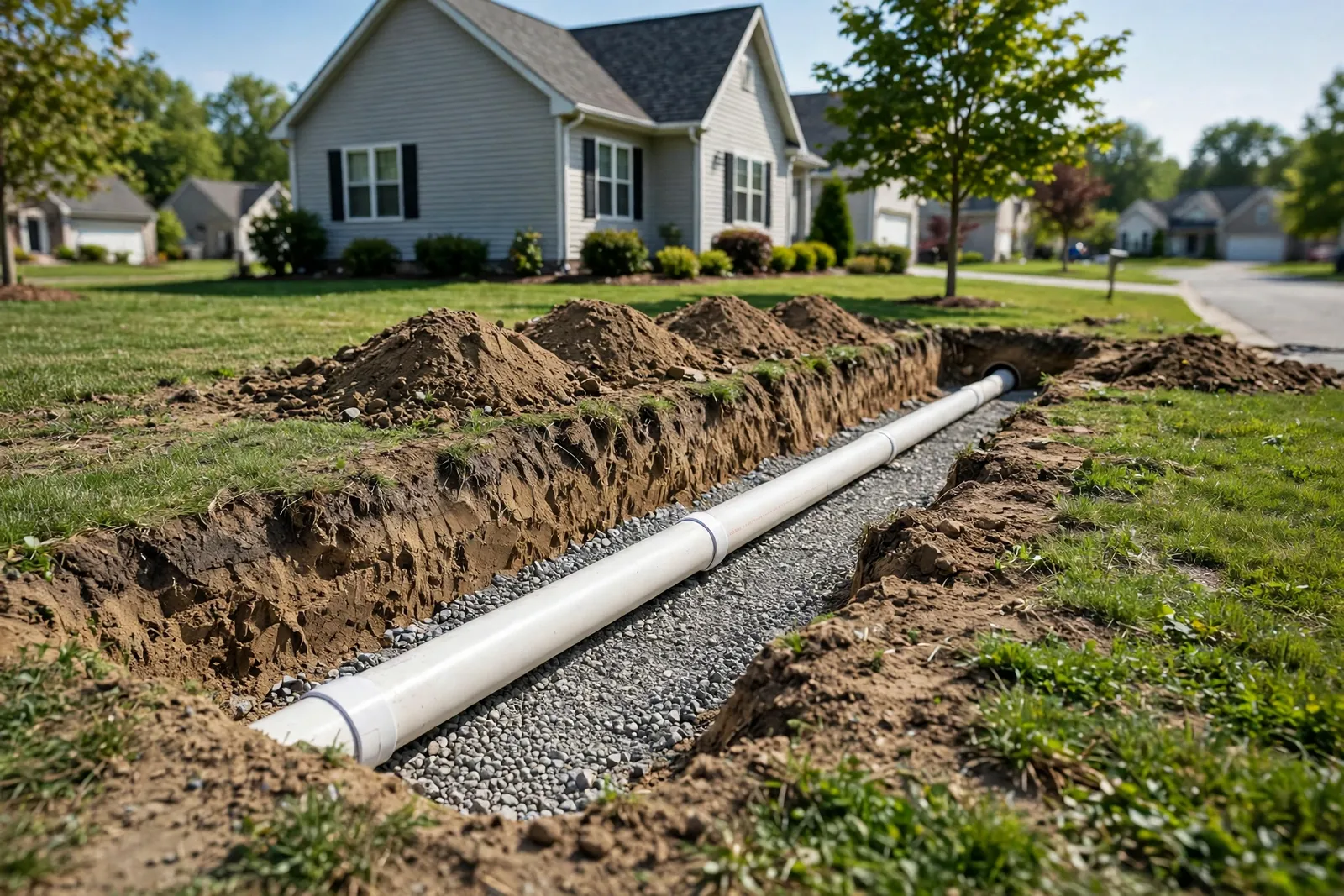
A line with roots at four joints, or a long belly, or clay crumbling along its run is a different answer. Replacing the full lateral from the house to the street connection costs more than a spot repair and less than three spot repairs across five years, which is the honest comparison. New work goes in as Schedule 40 PVC, bedded on gravel so the slope holds evenly along the whole run, because a new pipe laid at the wrong pitch is just a future belly installed on purpose.
Either way, the dig is aimed. The camera's distance measurement puts the excavation over the failure instead of across the yard, and the trench is checked before backfill so the slope that was designed is the slope that got buried.
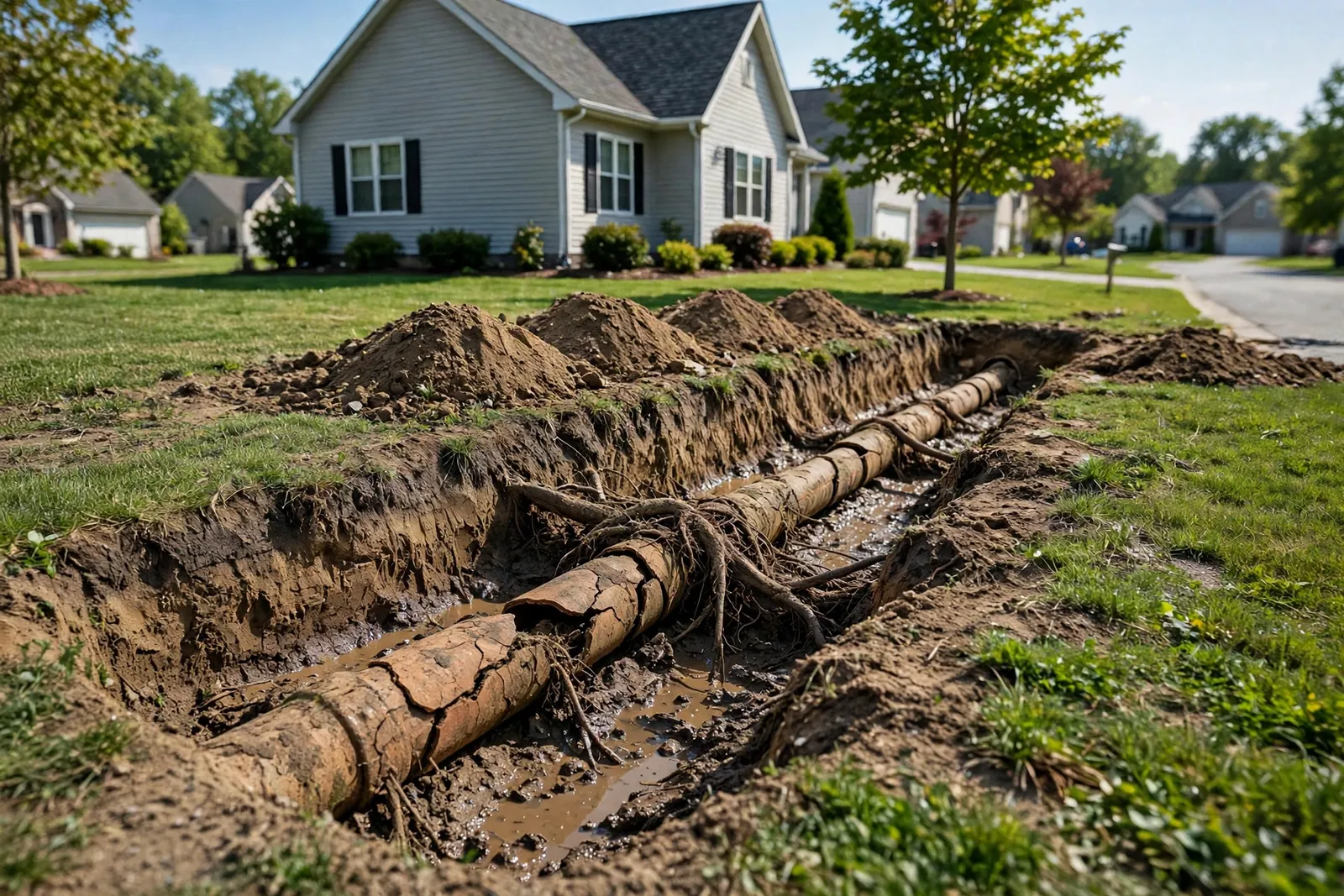
A St. Charles two-story had backups in the lowest bathroom twice in one season, and the camera found the cause at thirty feet out: a clay section that had bellied badly and grown a root mass at the low point. The pipe upstream and downstream of the sag was sound, so the crew opened a targeted trench, cut out roughly thirty feet of failed clay, and laid new PVC on a gravel bed graded to hold its slope, then backfilled once the open line was checked.
Because no Waldorf plumbing company publishes local pricing, this section uses the published national ranges from Angi 2026 cost guides and says so openly. Plan with them, then send the quote form for the range on your lateral.
Sewer line replacement runs $3,000 to $10,000 nationally, with the spread set by length, depth, and what the surface above the line needs restored afterward. A spot repair of one failed section sits at the lower end of that range because the dig is small and the pipe footage is short. A full lateral replacement on a deep line under a driveway sits at the top.
What moves the figure is mostly underground geometry. Depth decides how much earth moves and how the trench is held open. Length decides pipe and labor. Surface decides restoration: a line under lawn is cheaper to reach than one under a concrete driveway or a mature garden bed you want kept. The camera run up front is what keeps these variables honest, because the quote is built on the failure's actual location rather than a guess at it.
Homeowners ask us how they will know whether their line is a candidate for one repair or a replacement conversation, and the camera footage usually answers it in a single viewing. Sound pipe with one accident, a cracked joint where a root found its way in, a fitting that separated, is a pipe with decades left and one bad spot. That is a spot repair, confidently.
A failing line looks different: roots at joint after joint, cracks running lengthwise, sections visibly ovalled or sagging, orangeburg or clay crumbling where the camera light catches it. Patching the worst spot on a line like that buys a season and schedules the next dig. When the footage shows that picture, we will walk you through it frame by frame and show you why the replacement math wins, so the decision is made on what you saw rather than on our say-so.
Published national ranges from Angi 2026 run $3,000 to $10,000 for replacement, depending on length, depth, and surface restoration. A spot repair of one failed section costs less. No Waldorf company publishes local pricing, so send the quote form and we will give you the range once a camera shows the failure.
Drains slowing throughout the whole house at once, toilets gurgling when other fixtures drain, sewage odors in the yard, and a strip of lawn over the line that stays green and soft in dry weather. One slow fixture is a clog; the whole house talking at once is the lateral.
Most replacements take one to three days depending on depth and length. A spot repair of one section often finishes in a day or two. The trench is checked before backfill, and fixtures return to service as soon as the new line is connected and tested.
Almost never. The camera measures the failure's distance from the house, so the excavation opens over the failed section instead of along the whole run. A full replacement opens a trench line, but even then the dig follows the pipe and nothing wider than the work requires.
Roots can be cut out of a line, and for a sound pipe with one intruded joint that may be all it needs for years. Where roots have cracked the pipe or the line has bellied, clearing schedules the next backup, because the opening the roots used is still there. The camera shows which situation you are in.
The form asks for your name, phone number, the service, and a short message. Describe which drains are affected and whether you have had backups. We respond with the published range for sewer work and set up the camera inspection that turns a suspicion into a scoped quote.
Tell us what is leaking, clogged, or running cold. We read every request that comes in and respond with the published national range for that kind of work and the next step, starting with a visit to confirm the diagnosis on site.
Prefer to talk it through first? Send the form and we will call you back at the number you give us.